 Deutsch (Deutschland)
  English (United Kingdom)
Featured

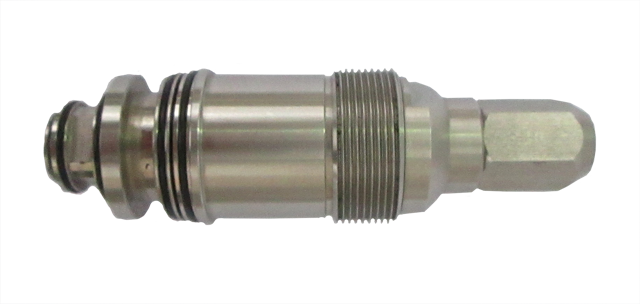
The APSON Minivalve VNT-3015 is a normally closed, pneumatically controllable 2/2-ways tandem-valve for aggressive work materials, e.g. lacquers, solvents, alkalis. It operates with the standard pneumatic pressures of the industry. It is mainly used in special applications as well as in APSON SRS safety lacquer changers.
Fig. 1: APSON Minivalve VNT-3015
Features
-
Work material supply through hollow valve needle, casing very compact and smaller diameter.
-
Valve closes tight with the casing, thereby good rinsing in the valve block.
-
Compact 2-pistons tandem-valve, suitable for the standard pneumatic pressures of the industry.
-
Metallic parts made of stainless steel, seals are resistant against aggressive work materials.
-
Mounting in the valve block by pluggable connection and secured by locking screw.
-
Assembly and disassembly using simple tools.
Structure and Function
The APSON Minivalve VNT-3015 is a normally closed 2/2-ways valve. The casing and parts are made of stainless steel. The valve (see figure 2) mainly consists of a cylindrical casing with one axial inlet and one axial outlet, for the work material. Located inside the casing are three axially arranged chambers. Through these chambers leads pressure-tight an axial, movable hollow valve needle, at which two pistons and the main seal of the valve are fixed. The pneumatic control air is supplied through the valve block.
The two chambers on the inlet side each contain a pistons und are divided by them each into two partial-chambers - vent chamber and pressure chamber. If the pressure chambers are charged with compressed air, the valve opens. The air release is effected by ventilation holes. Due to the tandem design, the pushing forces of the two pistons sum. A compression spring in the first vent chamber closes the valve as soon as it is no longer charged with compressed air.
The chamber on the outlet side is the real valve chamber for switching of the work material. It has a sealing seat and contains the output of the hollow valve needle (radial throughput bores), as well as the main seal of the valve. The valve conducts the working material through the hollow valve needle with good throughput.
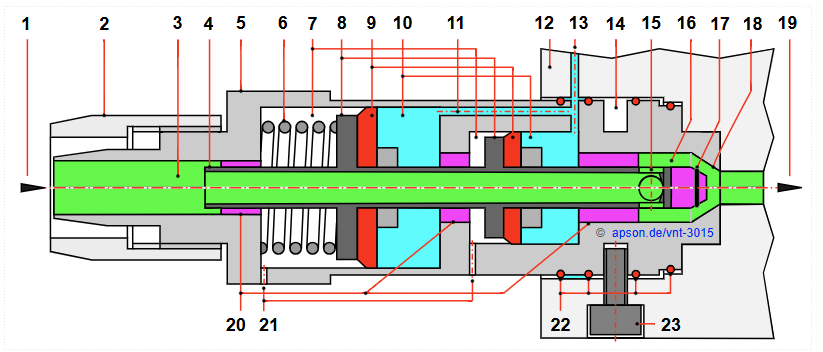
Fig. 2: APSON Minivalve VNT-3015 - Structure and Function
Legend: 1=inlet for work material, 2=hose connector, SL hose-nut, 3=work material, 4=hollow valve needle, 5=valve casing, 6=compression spring, 7=vent chambers, 8=pistons, 9=piston seals, 10=pressure chambers, 11=control-air channel, 12=valve block, 13=inlet for pneumatic control air, 14=periferal locking groove, 15=throughput bores from hollow valve needle to the valve chamber, 16=valve chamber, 17=main seal of the valve (for better understanding of the flow of the work material, the valve is shown in the activ, open status), 18=sealing seat of the main seal, 19=outlet for the work material, 20=valve needle seals, 21=ventilation bore holes, 22=case sealings, O-rings, 23=locking screw.
Technical Data
| Designation: | APSON Minivalve VNT-3015 |
|---|---|
| Valve type: | Normally closed, 2/2-ways |
| Work materials: | Solventborn and waterborn lacquers, solvents, alkalis, a.o. |
| Work material pressure: | Max 30 bar, hose-nut for hose [mm] d x D = 6 x 8 |
| Pneumatc control air pressure: | 6 to 8 bar |
| Casing parts: | Stainless steel |
| Main seal of hollow valve needle: | Kalrez™ |
| Seals for pistons and valve needle cone: | UHMWP (Ultra High Molecular Weight Polyethylene) |
| Casing sealings: | Viton™, or on customers request |
| Casing dimensions [mm] L x M: | Approx. 80 x M 24 |
| Mass: | Approx. 100 g |
| Approvals: | CE |
Ordering Data
| Designation | Ordering-Nr. |
|---|---|
| APSON Minivalve VNT-3015 | 060A070 |
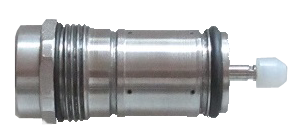
The APSON Minivalve VNT-3015 is a normally closed, pneumatically controllable 2/2-ways tandem-valve for aggressive work materials, e.g. lacquers, solvents, alkalis. It operates with the standard pneumatic pressures of the industry. It is mainly used in special applications as well as in the APSON Mini Lacquer Changer LCM-2010.
Fig. 1: APSON Minivalve VNT-3011
Features
-
Indicator for switch status and sealage resp. leakage.
-
Very compact 2-pistons tandem-valve, suitable for the standard pneumatic pressures of the industry.
-
Metallic parts made of stainless steel, seals are resistant against aggressive work materials.
-
Assembly and disassembly using simple tools.
3. Structure and Function
The APSON Minivalve VNT-3011 is a normally closed 2/2-ways valve. The casing and parts are made of stainless steel. Located inside the casing, (see figure 2), are two axially arranged pressure chambers, each with a piston and piston seal. Through these chambers leads pressure-tight an axial, movable hollow valve needle, at which the two pistons and the main seal of the valve are fixed. The rear part of the valve needle is visible and contains an axial bore. This allows to determine the switching state and the sealage or leakage of the valve. The work material and the pneumatic control air are supplied through the valve block.
If the pressure chambers are charged with compressed air, the valve opens. The air release is effected by ventilation holes. Due to the tandem design, the pushing forces of the two pistons sum. A compression spring in the compression spring chamber closes the valve as soon as it is no longer charged with compressed air. The actual valve chamber for switching of the work material and the sealing seat of the main seal are located in the respective valve block (see APSON Mini Lacquer Changer LCM-2010).
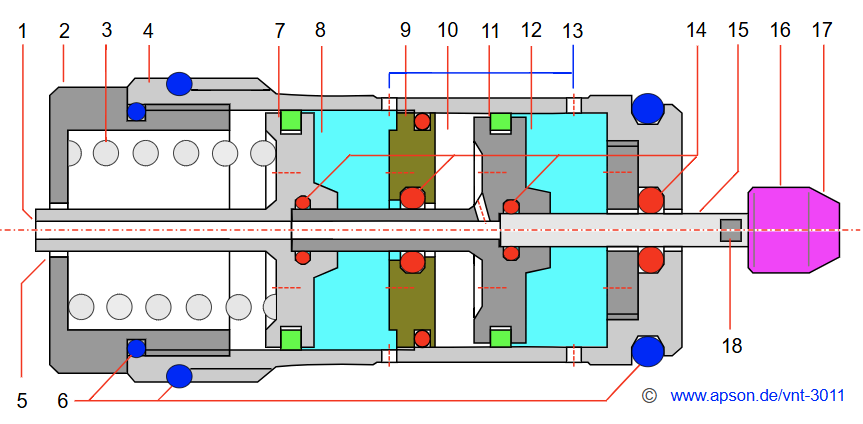
Fig. 2: APSON Minivalve VNT-3011 - Structure (simplified representation)
Legend: 1=indicator for the switching state and the sealage or leakage, 2=housing lid, 3=compression spring, 4=valve housing, (wrench size 17 mm), 5=venting bore of the pressure spring chamber, 6=housing seals, O-rings, 7=rear piston with piston seal, 8=rear pressure chamber, 9=sealing plate for the pressure chamber, 10=vent space, 11=front piston with piston seal, 12=front pressure chamber, 13=control-air channels, 14=valve needle seals, 15=valve needle, 16=main seal of the valve, 17=wrench surface (wrench size 1.5 mm).
Technical Data
| Designation: | APSON Minivalve VNT-3011 |
|---|---|
| Valve type: | Normally closed, 2/2-ways |
| Work materials: | Solventborn and waterborn lacquers, solvents, alkalis, a.o. |
| Work material pressure: | Max. 15 bar |
| Pneumatc control air pressure: | 6 to 8 bar |
| Materials: | Housing parts: stainless steel, housing seals: Viton™ |
| Seals of valve needle and pistons: | Teflon™ and/or Kalrez™, or on customers request |
| Main seal, valve needle cone: | UHMWP (Ultra High Molecular Weight Polyethylene) |
| Dimensions [mm] L x M, WS: | Approx. 47 x (M 17 x 1), wrench size 17 |
| Mass: | Approx. 30 g |
Ordering Data
| Designation | Ordering-Nr. |
|---|---|
| APSON Minivalve VNT-3011 | 060A060 |
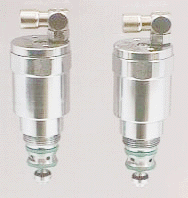
The APSON 3/2-Ways Lacquer Valve 2004 is a pneumatically controllable compact needle valve made of inoxidable steel. It fulfills its function together with modules intended therefore, e.g. valve blocks, lacquer distributors, sprayheads, a.o. Valves of this type are designed as 3/2-ways valves for aggressive non-granular fluid media, e.g. lacquers, solvent, caustic solutions, a.o. They serve for switching the medium stream into two from each other separated media circuits
.
The installed valve must be outward absolutely tight:
APSON 3/2-Ways Lacquer Valve 2004
Features
-
Fast error recognition in the lacquer system by directly evident switching status.
-
Early detecting of leakage of the medium as well as the pneumatics air.
-
Manual toggling of the valve with a special tool possible.
-
Fast valve exchange, and efficient maintenance and spareparts management.
-
Small pressure losses between medium inlet and medium outlets.
-
Very good rinsing characteristics, because of APSON deadthroom-free valve technology.
-
Very compact design.
Structure and Function
The valves consist of the drive in the pneumatics chamber, a seal packing in the intermediate chamber and the two medium seals in the medium chamber (actual valve). The valves have a mechanical visual display of the switching status.
APSON 3/2-Ways Lacquer Valve 2004
The drive consists of the pneumatic cylinder, a piston with sealing diaphragm, the valve needle and the pre-compressed spring for closing the valve, if the valve is not addressed with compressed air. The piston and the valve needle are rigidly connected together.
The seal packing (medium barrier) consists of several seals, which manage the sealing at the valve needle by means of a pre-compressed spring, on the one hand to the medium chamber and on the other hand to the pneumatics chamber.
The medium seals consist of the valve needle head and two seals, which withstand aggressive media. All seals of the valve must therefore be adapted to the media which are to be used.
The mechanical visual display consists of a display pin for the switching status of the valve. The display pin is rigidly connected with the valve needle. The valve can be switched by pulling on the display pin manually. Optionally the possibility exists for sensing electrically the status of the valve by means of a proximity sensor.
In the screwed in status with the appropriate valve block, the valve forms one discrete medium chamber, with one inlet and two outlets each with axial sealing seats for the medium.
The outlet wich in normal condition (without control signal) is closed is called normally closed outlet. The other outlet is called thus normally open outlet.
In the inactive status (normal condition), no compressed air or control signal pends, and the normally closed outlet is closed and the normally open outlet is open.
In the active status, the valve is controlled with compressed air, and the piston formed by the diaphragm connected with the valve needle squeezes a spring together. Thereby the status of the outputs is toggled and the normally closed output is opened and the normally opened output is closed.
Technical Data
| Denomination: | APSON 3/2-Ways Lacquer Valve 2004 |
|---|---|
| Media: | Aggressive media (lacquer, solvent, caustic solution, a.o. |
| Medium pressure: | approx. 12 bar (or in accordance with customer's request) |
| Pneumatics air pressure: | 6 to 8 bar |
| Medium-touching housing parts: | Inoxidable steel |
| Piston seal: | Teflon™ |
| Main seals: | Teflon™ (optional Kalrez™) |
| Housing seals: | Viton™ |
Service Life
For the APSON 3/2-Ways Lacquer Valve 2004 the following service lives were determined within the basecoat area. The service life for valves, at operation with basecoat lacquer amounts to approx. 500,000 switching cycles. For a troublefree operation of this lacquer valve type, all 300,000 switching cycles a visual inspection must be executed. The visual inspection is to be executed first at the installed valve and afterwards in the unscrewed status.
The installed valve must be outward absolutely tight:
-
If pneumatic air withdraws from the bleed bore (annular gap cover), the pneumatic seal at the piston must be exchanged.
-
If pneumatic air withdraws from the exhausting drilling of the valve needle, the piston sided seal (air side) of the valve needle for the pneumatic control air must be exchanged.
-
If lacquer withdraws from the exhausting drilling of the valve needle, the seal at the valve needle (lacquer side) must be exchanged.
At the unscrewed valve the following critical parts are to be checked for wear:
-
Main seals of the needle
-
O-rings of the valve
-
Needle seals to compressed air side or lacquer side
Important: After approx. 300,000 switching cycles the compression spring in the pneumatics chamber must be exchanged by a new greased compression spring. The exchange can be managed without unscrewing the valve from its valveblock within one minute. For safety reasons the medium should be switched pressure-free during the exchange of the spring. Eventually the inner surface of the pneumatic cylinder is to be coated again with valve fat.
Ordering Data
| Denomination | Part-Nr. |
|---|---|
| APSON 3/2-Ways Lacquer Valve 2004 | 060-A015 |
Options:
-
Main seal from Kalrez™
-
Non medium-touching housing parts from aluminum
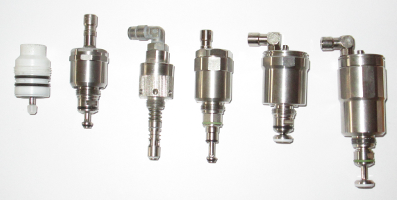
APSON 2/2-Ways Lacquer Valves 200x are pneumatically operatable compact needle valves made of inoxidable steel. They fulfill their function together with modules intended therefore e.g. valve blocks, lacquer distributors, sprayheads etc. They are designed for applications with aggressive non-granular fluid media, e.g. lacquers, solvents, caustic solutions, a.o.
APSON 2/2-Ways Lacquer Valves (e.g. 2000, 2003 and 2002)
Features
-
Fast error recognition in the lacquer system by directly evident switching status.
-
Early detecting of leakage of the medium as well as the pneumatics air.
-
Mechanical operation of the valve with a special tool possible.
-
Delimitation of the flow rate by variable operating path.
-
Fast valve exchange, and efficient maintenance and spareparts management.
-
Small pressure losses between medium inlet and medium outlet.
-
Very good rinsing characteristics, because of APSON deadroom-free valve technology.
-
Very compact design.
Structure and Function
The valves are built from the drive in the pneumatics chamber, a seal packing in the intermediate chamber and the medium seals in the medium chamber (actually the valve). Furthermore the valves have a mechanical visual display for the switching status.
APSON 2/2-Ways Lacquer Valves (e.g. 2000, 2003 and 2002)
The drive consists of the pneumatic cylinder, a piston with sealing diaphragm, the valve needle and the pre-compressed spring for closing the valve, if the valve is not addressed with compressed air. The piston and the valve needle are rigidly connected together.
The seal packing (medium barrier) consists of several seals, which manage the sealing at the valve needle by means of a pre-compressed spring, on the one hand to the medium chamber and on the other hand to the pneumatics chamber.
The medium seal consists of the valve needle head and seals which withstand aggressive media. All seals of the valve must therefore be adapted to the media which are to be used.
The mechanical visual display consists of a display pin for the switching status of the valve. The display pin is rigidly connected with the valve needle. The valve can be switched by pulling on the display pin manually. Optionally the possibility exists for sensing electrically the status of the valve by means of a proximity sensor.
In the screwed in status with the appropriate valve block, the valve forms one discrete medium chamber each with a radial inlet and an axial outlet with sealing seat for the medium.
In the inactive status (normal condition), if no compressed air or control signal pends, the valve is closed. In the active status, when the valve is subjected with compressed air, the piston provided with a fastened diaphragm and fixed at the valve needle squeezes the recoil spring together. Thereby the valve needle is raised from its sealing seat at the axial outlet. Thus the flow of the medium is released.
Technical Data
| Denomination: | APSON Lacquer Valves 200x |
| Media: | Aggressive media (lacquer, solvent, caustic solution, a.o.) |
| Medium pressure: | approx. 12 bar (or in accordance with customer's request) |
| Pneumatic control air pressure: | 6 to 8 bar |
| Medium-touching housing parts: | Inoxidable steel |
| Piston seal: | Teflon™ |
| Main seal: | Teflon™ (optional Kalrez™ or FFKM™) |
| Housing seals: | Viton™ |
Service Life
For the APSON Lacquer Valves 200x the following service lives were determined within the basecoat area. The service life for valves, at operation with basecoat lacquer amounts to approx. 500,000 operating cycles. For a troublefree operation of the lacquer valves all 300,000 operating cycles a visual inspection must be executed. The visual inspection is to be executed first at the installed valve and afterwards in the unscrewed status.
The installed valve must be outward absolutely tight:
-
If pneumatic air withdraws from the bleed bore (annular gap cover), the pneumatic seal at the piston must be exchanged.
-
If peumatic air withdraws from the exhausting drilling of the valve needle, the piston sided seal (air side) of the valve needle for the pneumatic control air must be exchanged.
-
If lacquer withdraws from the exhausting drilling of the valve needle, the seal at the valve needle (lacquer side) must be exchanged.
At the unscrewed valve the following critical parts are to be checked for wear:
-
Main seal of the needle
-
O-rings of the valve
-
Needle seals to compressed air side or to the lacquer side
Important: After approx. 300,000 switching cycles the compression spring in the pneumatics chamber must be exchanged by a new compression spring. The exchange can be made with installed valve within one minute. For the sake of safety, the medium can be switched pressure-free. Eventually the inner surface of the pneumatic cylinder is to be coated again with valve fat.
Ordering Data
| Denomination | Part-Nr. |
|---|---|
| APSON 2/2-Ways Lacquer Valve 2015, PF2 (for Lacquer Changer 2000, a.o.) | 060-A030 |
| APSON 2/2-Ways Lacquer Valve 2016, PF2 (for Lacquer Changer 2009, 2010, a.o.) | 060-A031 |
| APSON 2/2-Ways Lacquer Valve 2017, PF2 (for Lacquer Changer 2008 N, a.o.) | 060-A033 |
| APSON 2/2-Ways Lacquer Valve 2017, T3 (for Lacquer Changer 2008 N, a.o.) | 060-A035 |
| APSON 2/2-Ways Lacquer Valve 2014, T3 (for Lacquer Changer 2000, a.o.) | 060-A029 |
| APSON 2/2-Ways Lacquer Valve 2014, P (for Lacquer Changer LCLT-20K4 and LCLT-25K4, a.o.) | 060-A039-6 |
| APSON 2/2-Ways Lacquer Valve 2000 with special seal (for Lacquer Changer 2000, a.o.) | 060-A008 |
| APSON 2/2-Ways Lacquer Valve 2000 (for Lacquer Changer 2000, a.o.) | 060-A010 |
| APSON 2/2-Ways Lacquer Valve 2009, PF2 | 060-A013 |
| APSON 2/2-Ways Lacquer Valve 2001 - (old!) | (060-A002) |
| APSON 2/2-Ways Lacquer Valve 2002 (for lacquer Changer 2007) | 060-A004 |
| APSON 2/2-Ways Lacquer Valve 2003 (for APSON Sprayhead 200x) | 060-A011 |
Options
-
Main seal of Kalrez™
-
Non-medium-touching housing parts from aluminum

The APSON Quickchange Paint Pressure Regulators PRP-3030-K are pneumatically controlled or ...

The APSON Lacquer Changer LCM-2010 Mini is a very compact paint changer for aggressive, ...

APSON 2/2-Ways Lacquer Valves 200x are pneumatically operatable compact needle valves made of ...

The APSON Backstroke Valve BSV-2005 G1/4" with flat seal is an automatically switching compact ...

Standard Lacquer Changers are usually built as a series of bolted together valve blocks, with ...

The APSON Hosemountingtool HMT-1012 is a multi-purpose tool for cutting and widening of ...

APSON Backstroke Valves (Checkvalves) of above-mentioned type are automatically switching compact ...

The APSON Secondary-Circuits Rinsinggroup CSC-2000 serves to divide long lacquer lines into ...

The APSON Lacquer Changer LCC-2007 Compact is particularly suitable for applications in systems ...

The APSON 2C Switching Block XMY-2009 HB with Backpropagation belongs to the class of the ...

The APSON Lacquer Pressure Regulator PRP-2001 is a pneumatically controllable pressure regulator ...

APSON spray bells are high-speed rotators for yielding and fine dissipation of liquid media. ...

The APSON Minivalve VNT-3015 is a normally closed, pneumatically controllable 2/2-ways ...

The APSON Turbo-Pulse Cleaner CTP-2001 is a pneumatically controllable rinsing block for aggressive ...

The APSON Pulse Cleaner CPP-2000 is a pneumatically controllable rinsing block for aggressive ...

The APSON Minivalve VNT-3015 is a normally closed, pneumatically controllable 2/2-ways ...

The APSON Backflow Controlvalve BCV-2002-P is a mechanically adjustable overpressure valve for ...
Through the attachment of the APSON Pump Rinsingblock CPY-2000 to the rinsable types of the ...

A regulated temperature of the spraying material - the prerequisite for optimum painting
The ...

The APSON Lacquer Changer LCLT-25K4 Inline is a modular expandable switching unit for pressurized ...
Contact details
APSON Lackiertechnik GmbH
Am Wiesengrund 15
63075 Offenbach
Fon: +49 69 82369 447
Fax: +49 69 82369 448
E-Mail: email@apson.de
Contact form